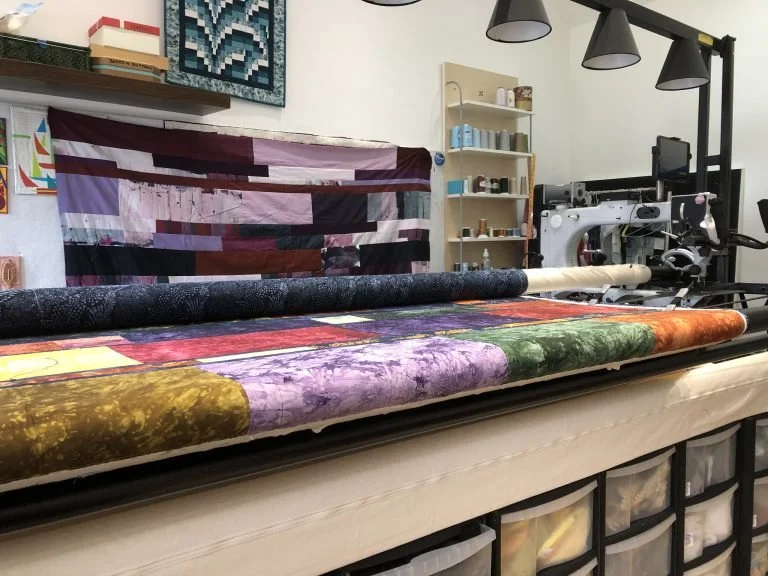
I offer professional longarm quilting to give your quilt the perfect finish. Using my Gammill Vision 2.0 Elevate longarm machine, I provide a range of options including edge-to-edge, free-motion, and computerised designs. Whether you prefer a simple, traditional look or a more intricate contemporary style, I will work with you to choose a design that complements your quilt and enhances its story.
Longarm services
Pricing
Quilting is priced according to the density of the design, from simple through to detailed finishes, and I can accommodate quilts from cot size up to king size. In addition to quilting, I also offer basting services for those who wish to complete the quilting themselves.
To make your quilting journey easier, I stock a selection of binding, backing, and wadding in a variety of styles and materials, ensuring you have everything you need to achieve the perfect result.
Every quilt is unique, and my goal is to highlight your creativity while adding texture, depth, and beauty to your work.
-
Cot £85
Lap £120
Single £145
Double £165
King £185
-
Cot £100
Lap £140
Single £180
Double £200
King £225
-
Quilts requiring complex patterns including stitch in ditch, stitch around applique, blocks and borders, and special placement of designs require prior consultaiton and are custom designwork pieces.
Custom designwork prices are available based on consultation.
-
Basting Small £30
Basting Medium £45
Basting Large £65
-
From £30 plus £30 for finishing
-
Backing £15.00per metre
Wadding
Sew Simple Cotton £16.00 per metre
Sew Simple Cotton White £16.00 per metre
Sew Simple 80/20 £14.00 per metre
Sew Simple Polyester £12.00 per metre
Preparing your quilt
For the best results always square the quilt to the best of your ability then press and fold ready for longarming.
Quilt top
Trim all loose threads from both the front and back. This is especially important when working with light fabrics, as stray threads may show through after quilting. Use a product like Fray Check to prevent fraying if needed.
Ensure all seams are secure, paying particular attention to the edges where piecing joins meet.
Backing fabric
Backing fabric should be at least 4″ larger than your quilt top on all sides and squared as accurately as possible.
Do not seam with selvedge edges. Selvedges should be positioned at the outer edges (top and bottom) of the quilt, as they can cause tension issues and puckering if placed in the centre.
If your backing requires a join, avoid placing it symmetrically, as perfect squaring cannot be guaranteed. Ideally, seams should run horizontally to the quilt top. Fully pieced backings are also welcome, provided seams are secure and the grain and tension are aligned.
Wadding
Wadding should be at least 2″ larger than your quilt top on all sides.
Do not wash wadding before use. Instead, unroll it and allow it to rest. Light steaming can be used to remove creases.